 ultimate-guide
What to Look for in Wedding Venues: 2026 Guide
Last Updated: October 23, 2026
Quick Summary
Score wedding venues on six weighted categories: total cost transparency (25%), capacity and layout (20%), date availability (15%), location and accessibility (15%), included amenities (15%), and contract flexibility (10%). Verify all-in costs, real seated capacity, hold policies, inclusions, vendor flexibility, and contract terms in writing before you book.
- Build a written checklist before touring so you compare facts instead of feelings.
- Ask for an all-in estimate covering service charges, staffing, and required add-ons.
- Divide each venue's total cost by your guest count to compare true per-guest cost.
- Confirm the rain plan, backup space, and weather decision deadline in the contract.
- Ask whether the preferred-vendor list is required or merely recommended.
Table of Contents
- How to Evaluate Wedding Venues: A Decision Framework
- Your Wedding Venue Checklist: What to Verify Before You Book
- Wedding Venue Cost and Budget: What the Rental Fee Actually Covers
- Capacity, Layout, and Guest Flow: Will 150 Guests Feel Cramped?
- Location, Parking, and Accessibility for Every Guest
- Questions to Ask Wedding Venues: Contracts, Vendors, and Contingencies
- The Wedding Venue Tour Checklist: What to Inspect in Person
- Conclusion
- Frequently Asked Questions
How to Evaluate Wedding Venues: A Decision Framework
The U.S. hosts roughly 2 million weddings a year across about 35,800 venues, according to MMC Group's U.S. Wedding Venue Market investment thesis, and that volume means couples rarely get a second chance at a first impression. Knowing what to look for in wedding venues starts with one shift in mindset: stop shopping for the prettiest room and start scoring venues against the same criteria, in the same order, every time.
Here's the framework we recommend. Score each venue from 1 to 5 on six weighted categories: total cost transparency (25%), capacity and layout (20%), date availability (15%), location and accessibility (15%), included amenities (15%), and contract flexibility (10%). Multiply each score by its weight and add the totals.
That's the theory. Here's where it breaks down in practice.
Score every venue on the same six weighted categories so the comparison stays honest.
| Category | Weight |
|---|---|
| Total cost transparency | 25% |
| Capacity and layout | 20% |
| Date availability | 15% |
| Location and accessibility | 15% |
| Included amenities | 15% |
| Contract flexibility | 10% |
Your Wedding Venue Checklist: What to Verify Before You Book
A wedding venue checklist is a written list of the non-negotiables you verify before signing, covering cost, capacity, availability, inclusions, and contract terms. Build it before you tour so you're comparing facts instead of feelings.
Verify these before you book:
- Total cost, not the headline rental fee. Ask for an all-in estimate including service charges, staffing, and required add-ons.
- Real capacity. Seated capacity differs from standing capacity. Confirm both.
- Date availability and hold policies. Ask how long a courtesy hold lasts and what releases it.
That last item is where most couples get burned, and it's the one competitors skip.
Wedding Venue Cost and Budget: What the Rental Fee Actually Covers
The rental fee rarely tells the whole story. Venue pricing typically splits into three layers: the base rental, required services, and variable extras. The gap between the quoted number and the final invoice is where budgets break, and most couples never calculate that gap before signing. The fix is to build an all-in cost model for each venue before you compare anything.
The three cost layers
Layer 1: Base rental. The number in the brochure. It may cover a block of hours, a ceremony space, a reception space, or all three. Ask what the base rental includes and what it excludes, in writing.
Layer 2: Required services. These are the charges you cannot decline if you book the venue. Common examples include:
- Service charges and administrative fees, often a percentage on top of catering or the rental fee
- Staffing minimums (bartenders, servers, security) and overtime rates
- Required insurance or damage waivers
Layer 3: Variable extras. These depend on your choices and your guest count:
- Overtime charges if your event runs past the contracted end time
- Setup and breakdown fees for décor, rentals, or lighting
- Outside vendor fees if you bring your own caterer, DJ, or florist
How to calculate the true all-in number
Ask every venue for a written package overview that separates included amenities from add-ons, then run the same math for each shortlisted venue:
- Start with the base rental for your date and guest count.
- Add every required service charge and fee, including percentages on catering.
- Add your best estimate for variable extras based on your actual plans.
- Add applicable sales tax and any mandatory gratuity.
- Divide by your guest count to get a true per-guest cost.
That per-guest number is the only figure worth comparing across venues. A venue with a lower rental fee but a higher service charge and a staffing minimum can easily cost more per guest than a venue with a higher headline rate.
Questions that surface the real number
- What percentage is the service charge, and what does it apply to?
- Is there a food and beverage minimum, and does it include tax and service charge?
- What triggers overtime, and what is the hourly rate?
Pricing depends on your date, guest count, and setup needs, so request pricing directly rather than guessing from a brochure, and ask for the same written breakdown you would request from any venue.
Capacity, Layout, and Guest Flow: Will 150 Guests Feel Cramped?
Guest capacity is the maximum number of people a venue can legally and comfortably hold, and it must be measured against your actual guest count, not the venue's marketing maximum. A room that seats 200 theater-style may seat 130 at rounds with a dance floor, and that difference decides whether your reception feels generous or packed.
Venue layout and event flow matter as much as square footage. Ask these questions:
- Where does the ceremony space convert to the reception space, and how long does the flip take?
- Is there a separate bridal suite or getting-ready space, and is it included?
- Can guests move between cocktail hour and dinner without bottlenecking?
- Where do vendors load in, and is that path separate from guest traffic?
Location, Parking, and Accessibility for Every Guest
Location and accessibility decide whether guests arrive relaxed or rattled. Check parking capacity, rideshare drop-off points, and travel time from the nearest hotels before you commit, then walk the venue as an elderly guest or wheelchair user would.
Ask specifically about:
- Step-free entry and interior thresholds
- Accessible restrooms on the same level as the event
- Elevator access if the event space is upstairs
If you have elderly family members or a guest in a wheelchair, tour with them in mind and ask the coordinator to walk the actual route.
Questions to Ask Wedding Venues: Contracts, Vendors, and Contingencies
The questions to ask wedding venues that matter most are the ones about money, weather, and exit terms. Ask them early, in writing, and compare the answers side by side. This section turns those questions into a contract checklist, a weather decision framework, and a vendor logistics plan you can actually use on tour.
The contract checklist
Before you sign, confirm each of these in the written agreement:
- Deposit amount and refundability. How much is due to hold the date, and is any portion refundable if you cancel?
- Payment schedule. List every due date and the final balance deadline. Ask whether the final balance is due before or after your guest count is finalized.
- Cancellation policy. Confirm the tiers: what you owe if you cancel six months out versus thirty days out, and whether payments convert to a credit.
The weather contingency framework
For any venue with outdoor space, ask these four questions and write down the answers:
- What is the rain plan, and who decides when to use it? Confirm the decision deadline and whether the venue or the couple makes the call.
- Is there a backup indoor space, and is it included or an add-on? Ask whether the backup holds your full guest count for both ceremony and reception.
- What temperature control exists? Ask how the space is heated or cooled for your season and guest count, and whether tenting is required.
- What are the tent requirements? If a tent is needed, ask who supplies it, when it must be ordered, and whether the venue has preferred vendors.
A common pattern is a venue that requires a final weather decision 24 to 48 hours before the event. Put that deadline on your planning calendar and confirm it in the contract.
Vendor logistics and operational restrictions
Vendor rules are where budgets and timelines quietly break. Ask:
- Is there a preferred-vendor list, and is it required or recommended?
- What is the outside-vendor fee, if any, and does it apply per vendor or per category?
- What is the load-in path, and is it separate from guest traffic?
Hybrid indoor-and-outdoor venues hold a real booking advantage here. Fully Booked Venue's 2026 industry analysis notes that venues offering more flexibility, including hybrid indoor/outdoor options, are positioned to stay booked. That flexibility is worth paying for when your date lands in an unpredictable season, but only if the contract confirms the backup space is included rather than an add-on.
The Wedding Venue Tour Checklist: What to Inspect in Person
A wedding venue tour checklist is your in-person inspection list: the physical details a brochure can't show you. Bring it printed, take photos, and write notes on the spot. Memory flatters every venue you visit.
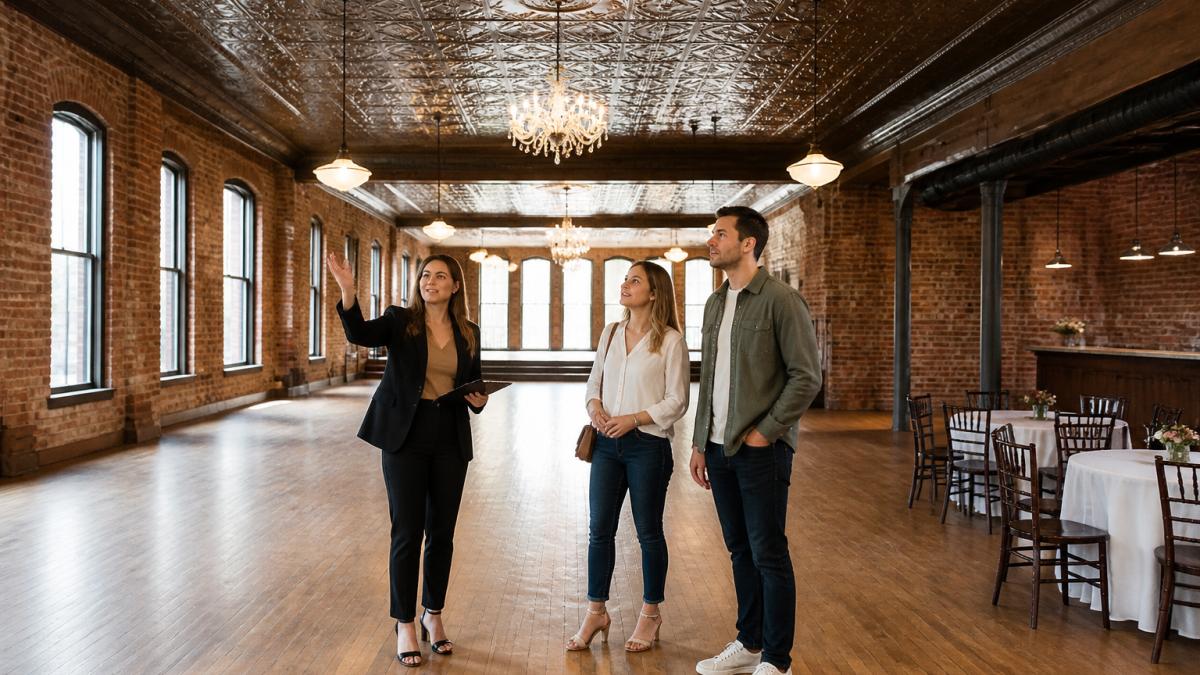
Inspect these on the walkthrough:
- Sound and lighting. Ask how the room handles a band versus a DJ, and whether lighting is included or rented.
- Temperature and airflow. Historic buildings can run warm. Ask how the space is cooled with a full guest count.
- Restrooms and coat space. Count them. Check cleanliness and capacity.
Our restored 1870 building pairs exposed brick and original tin ceilings with modern amenities. Ask to see real event photos, not just staged shots, so you know what the room actually looks like under event lighting.
Conclusion
The venues that disappoint couples are rarely the ugly ones; they're the ones nobody scored properly. Bring the framework, the checklist, and the contract questions to every tour, and compare venues on paper before you compare them in your heart.
If you want a space that pairs historic character with modern function, 1835 Event Hall offers exposed brick and original tin ceilings, a rustic speakeasy for cocktail hour, and a downtown location that's easy for guests to reach.
Frequently Asked Questions
What usually comes with a wedding venue?
Inclusions vary widely, so ask for a written package overview. Industry estimates cited by MMC Group indicate about 73% of venues include rentals such as tables, chairs, and linens, and 41% include catering. Everything else, from lighting to staffing to cleanup, may be extra. Confirm what is included and what is billed separately before you compare wedding venues on price alone.
What questions should you ask when touring a wedding venue?
Ask about the total cost beyond the rental fee, including service charges, overtime, and cleaning. Confirm guest capacity for both ceremony and reception spaces, rain backup plans, vendor restrictions, and load-in times. Request the cancellation and payment schedule in writing. Bring a wedding venue tour checklist so you compare answers side by side instead of relying on memory.
How much should you budget for a wedding venue?
Set your venue budget as a share of your total wedding budget, then request itemized pricing from each venue. Pricing depends on date, season, guest count, and what is included, so ask for a full quote rather than a headline rental fee. Build in a buffer for hidden costs such as overtime, staffing, and rentals not covered by the package.
What should you look for in a wedding venue contract?
Check the deposit amount, payment schedule, cancellation and postponement terms, and any force majeure clause. Confirm the contracted guest count, setup and breakdown times, vendor rules, and liability insurance requirements. Get every verbal promise in writing, including rain backup space and any included amenities, so the contract matches what you were shown on the tour.
What should to check about a venue's capacity and layout?
Ask for the seated capacity for your specific layout, not the standing maximum. Walk the room with your guest count in mind and check sightlines, dance floor space, and flow between ceremony and reception areas. Confirm whether the bridal suite and getting-ready space are included and how early you can access them on the wedding day.