 blog
How Do You Choose a Venue for Professional Gatherings?
Last Updated: October 26, 2026
Quick Summary
To choose a venue for professional gatherings, start with your event objectives, audience, and brand signal, then filter your shortlist on cost. Confirm capacity by setup, score location on travel time and accessibility, and compare venues on total cost of ownership rather than the rental fee alone.
- Write down your goal, audience, and brand signal before you tour any space.
- Ask for capacity by setup and subtract 10% for staging, bars, and buffet lines.
- Score each venue 1 to 5 on travel time, parking, transit, accessibility, and hybrid readiness.
- Build your total cost from rental fee, catering, rentals, AV, staffing, parking, and a 10% contingency.
- Never sign an attrition clause you haven't modeled against a realistic low-attendance scenario.
Table of Contents
- Start With Your Event Objectives and Business Culture
- Your Corporate Event Venue Checklist for Capacity, Layout, and Amenities
- How to Estimate Professional Event Venue Capacity
- Corporate Event Layout Ideas That Fit the Room and the Agenda
- Location, Parking, and Accessibility Requirements
- Budget, Rental Cost, and Total Cost of Ownership
- Event Venue Questions to Ask Before You Sign
- Book a Tour at 1835 Event Hall
- Frequently Asked Questions
Start With Your Event Objectives and Business Culture
Choosing a venue for professional gatherings starts with one question: what should this room make people feel and do? According to Cvent's 2026 event statistics roundup, 38% of planners pick their event location mainly on cost.
At 1835 Event Hall, we see the same pattern. Teams that arrive with clear objectives book faster and leave happier.
A professional gathering venue is a space selected to match an event's purpose, audience, and brand, not just its headcount. Get that match right and everything else gets easier.
Start by writing down three things:
- The goal: training, recruiting, fundraising, or celebration
- The audience: clients, staff, donors, or partners
- The brand signal: historic charm, modern minimal, or something in between
Then let your business culture narrow the list. A law firm's client dinner and a startup's team-building day need very different rooms. Neither is wrong. They just aren't the same event.
Your Corporate Event Venue Checklist for Capacity, Layout, and Amenities
A corporate event venue checklist keeps you from falling for a pretty room that fails on the basics.

Here is the checklist we would bring on any tour:
- Seated capacity with your actual seating style
- Standing capacity if you plan a reception
- Room dimensions and ceiling height
- Moveable walls or flexible furniture
- Audio, visual, and Wi-Fi capacity
- Catering kitchen access and vendor rules
- Restrooms and coat space for your group size
- Load-in times and setup windows
For a deeper framework, our guide on what to look for in wedding venues walks through the same evaluation logic room by room.
How to Estimate Professional Event Venue Capacity
Professional event venue capacity is the number of guests a room holds comfortably in your chosen setup, not the maximum the fire code allows. That difference decides whether your event feels generous or cramped. A 150-guest reception needs breathing room between tables, clear aisles, and space for a bar line that doesn't block the floor.
Use this quick estimate:
- Ask the venue for capacity by setup: theater, banquet, cocktail, and classroom
- Subtract 10% for staging, bars, and buffet lines
- Walk the room and picture your largest crowd moment
- Confirm restroom and exit capacity for that same number
If the math puts you near the limit, move up a room size. Nobody remembers a venue that felt tight.
Corporate Event Layout Ideas That Fit the Room and the Agenda
Corporate event layout ideas only work when the format drives the floor plan. Planners now expect venues to handle shifting formats without downtime, using features like moveable walls and reconfigurable furniture, per OLC Events' 2026 venue trends report.
Try these pairings:
- Theater rows: keynotes and all-hands meetings
- Round banquet tables: awards dinners and client meals
- Cocktail clusters: networking and fundraisers
- Classroom rows: training and workshops
- Mixed zones: a presentation area plus a lounge corner
Watch out: a layout that looks open on paper can clog at the doors. Always mark your entry, bar, and buffet paths on the floor plan before you commit.
Location, Parking, and Accessibility Requirements
Location decides attendance as much as content does. A downtown address near hotels and highways beats a scenic drive that adds 40 minutes. But "good location" is not a feeling, it is a set of measurable checks you can score before you commit.
Score location on travel time, not distance
Ask the venue for three numbers: average drive time from the nearest major airport, walk time from the closest hotel cluster, and the number of rideshare drop-off points. Then test them against your attendee list. If more than a third of guests are flying in, a venue more than 20 minutes from the airport adds real friction to arrival and departure. If most attendees are local, transit and parking matter more than airport proximity.
Confirm these before you fall in love with a space:
- Parking count versus your guest count (ask for the actual stall number, not "ample parking")
- Rideshare drop-off and pickup zones that don't conflict with load-in
- Public transit stops within a reasonable walk
- Signage from the parking area to the door, especially for evening events
- Noise levels from nearby streets and loading docks
Accessibility is a checklist, not a vibe
Accessibility requirements deserve the same scrutiny as capacity. Confirm step-free entry, elevator access, wide doorways, and accessible restrooms. Ask where wheelchair seating fits without blocking aisles. If elderly family members or guests with mobility needs are attending, walk the route yourself, from the parking lot to the seat.
Put these on your tour sheet:
- Step-free path from drop-off to the main room
- Elevator dimensions and whether it reaches every event space
- Accessible restroom count and location
- Reserved seating areas that don't isolate guests at the back
- Lighting levels for evening events and low-glare options for presentations
The hybrid and remote-participation layer most venues miss
If any part of your gathering is streamed or recorded, location and infrastructure overlap. Ask specifically about upload bandwidth for live streaming (not just download speed for guests), wired ethernet at the presenter position, microphone coverage for a room of your size, and whether the venue supports captioning or assistive listening. A room that photographs well can still fail a remote audience if the Wi-Fi chokes under a stream.
Turn it into a location score
Rather than debating impressions, score each shortlisted venue from 1 to 5 on travel time, parking, transit, accessibility, and hybrid readiness, then weight the categories to match your audience. A local training day should weight parking and transit heavily; a national conference should weight airport access and streaming. The venue with the highest weighted score wins the conversation, and you have a defensible reason to show your leadership.
Budget, Rental Cost, and Total Cost of Ownership
Rental cost is the number venues quote. Total cost of ownership is the number that actually hits your budget. The gap between them is where event budgets go to die.
Build your total from these lines:
| Cost Line | What to Confirm |
|---|---|
| Rental fee | Hours included, overtime rate |
| Catering | Minimum spend, service charge, tax |
| Rentals | Tables, linens, stage, dance floor |
| AV and tech | Screens, mics, Wi-Fi, technician fees |
| Staffing | Setup, security, cleaning |
| Parking | Guest and vendor parking |
| Contingency | 10% buffer for surprises |
Pricing at any venue depends on date, guest count, and inclusions, so ask for a full written quote rather than a headline rate. Compare venues on the total, never on the rental fee alone.
Event Venue Questions to Ask Before You Sign
Event venue questions to ask before signing fall into four groups: money, logistics, rules, and risk. Get answers in writing. A verbal promise about early access means nothing on the day of your event.
Most venue-selection articles stop at a question list. The real gap is contract mechanics, the terms that decide what you actually owe if plans change. Here is how to read them.
Money terms to pin down
- What exactly does the rental fee include and exclude?
- Is there a food-and-beverage minimum, and does it include tax and service charge?
- What is the overtime rate if your event runs long, and when does it start?
- Are setup, cleanup, security, and coat check billed separately?
- What is the deposit amount, and is it refundable?
Ask for the full written quote with taxes and service charges itemized. A headline rental rate that excludes a service charge and tax can land well above a competing quote that looked higher on the tour.
Logistics and rules
- When can we access the space for setup and vendor load-in?
- Are there preferred vendors, or can we bring our own caterer?
- What happens if we need to change the layout last minute?
- Is there a noise curfew or hard end time?
Risk terms that decide the real commitment
This is where small print bites hardest. Ask directly:
- Cancellation policy: What is the refund schedule by date? A common pattern is a full refund far out, a partial refund at a midpoint, and full liability inside a final window. Get the exact dates.
- Attrition clause: If you guarantee a guest count and fewer attend, what do you still owe? Many contracts hold you to a percentage of the guaranteed count or the food-and-beverage minimum.
- Force majeure: What events excuse performance, and who decides?
- Insurance: How much liability coverage does the venue require, and does your policy or the venue's cover it?
- Damage and deposit: What is withheld, and how is it returned?
A simple contract review routine
Before signing, do three things: request the full contract (not a summary), mark every dollar figure and every date, and ask the venue to confirm in writing any promise made on the tour. Then compare shortlisted venues on total commitment, deposit plus minimum plus cancellation exposure, not on rental fee alone. That comparison is the difference between a venue that fits your budget and one that fits your budget only if nothing goes wrong.
Book a Tour at 1835 Event Hall
The fastest way to judge a venue is to stand in it. Photos lie. Rooms don't.
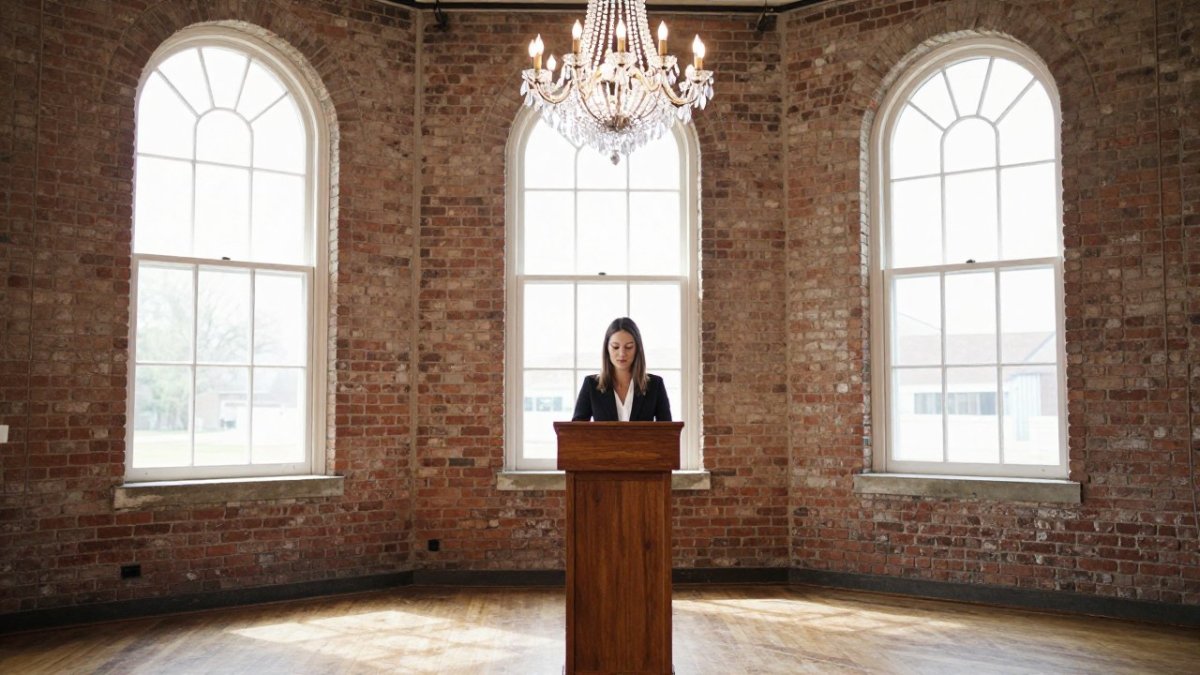
1835 Event Hall pairs a building from 1870 with the modern features a professional gathering needs: exposed brick, original tin ceilings, and a rustic speakeasy for after-hours conversation.
Bring your checklist. Bring your hardest questions. We will walk the floor with you and talk through capacity, layout, and what is included.
Get started with 1835 Event Hall and book a tour to see whether the room fits your event before you commit.
Frequently Asked Questions
What should you consider when choosing a venue for a professional gathering?
Start with capacity and layout: Tacoma Convention Center's 2026 trend summary reports that 50% of meeting professionals prioritize capacity and size, 44% prioritize services and facilities, and 42% prioritize cost. Then weigh location and parking, accessibility, available dates, audiovisual and Wi-Fi needs, catering rules, and contract terms. Build a scoring matrix so you compare venues on the same criteria instead of deciding on atmosphere alone.
What questions should you ask before booking an event venue?
Ask what the rental fee includes versus what costs extra, including setup and cleanup time, tables, chairs, linens, audiovisual equipment, and Wi-Fi. Confirm capacity limits for your specific seating layout, vendor policies and preferred vendor lists, cancellation terms, and any restrictions tied to the building's age. Also ask about accessibility routes, parking, and available dates so your booking timeline stays realistic.
How do you estimate the right venue capacity for a business event?
Divide your guest count by the room's usable square footage for your chosen layout. Theater seating fits more people than rounds, and rounds fit more than a reception setup with standing areas. Leave room for a stage, buffet lines, and bars, and confirm the venue's posted capacity limit rather than relying on a rough guess. A site visit lets you see whether 150 guests will feel comfortable or cramped.
How can you compare event venue costs and packages?
Compare total cost, not the headline rental rate. Add catering minimums, service charges, audiovisual rental, parking, insurance, and overtime fees. The Cvent 2026 statistics roundup notes that 38% of planners select their event location primarily based on cost, so ask for an itemized quote and check what is included. Pricing depends on dates, guest count, and setup, so request a current quote directly from the venue.